The SURVEYREG Procedure
Testing
Testing Effects
For each effect in the model, PROC SURVEYREG computes an  matrix such that every element of
  is estimable; the matrix has the maximum possible rank that is associated with the effect. To test the effect, the procedure uses the Wald F statistic for the hypothesis
  . The Wald F statistic equals
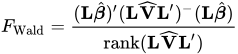
with numerator degrees of freedom equal to  .
.
In the Taylor series method, the denominator degrees of freedom is equal to the number of clusters minus the number of strata (unless you specify the denominator degrees of freedom with the DF= option in the MODEL statement). For details about denominator degrees of freedom in replication methods, see the section Denominator Degrees of Freedom. It is possible that the matrix cannot be constructed for an effect, in which case that effect is not testable. For more information about how the matrix is constructed, see the discussion in Chapter 16, The Four Types of Estimable Functions.
You can use the TEST statement to perform F tests that test Type I, Type II, or Type III hypotheses. For details about the syntax of the TEST statement, see the section TEST Statement in Chapter 20, Shared Concepts and Topics.
Contrasts
You can use the CONTRAST statement to perform custom hypothesis tests. If the hypothesis is testable in the univariate case, the Wald F statistic for  is computed as

where is the contrast vector or matrix you specify,  is the vector of regression parameters,
  ,
,  is the estimated covariance matrix of
  , rank() is the rank of , and
  is a matrix such that
- has the same number of columns as
- has full row rank
the rank of
equals the rank of the matrix all rows of
are estimable functions the Wald F statistic computed using the
matrix is equivalent to the Wald F statistic computed by using the matrix with any row deleted that is a linear combination of previous rows
If is a full-rank matrix and all rows of are estimable functions, then is the same as . It is possible that matrix cannot be constructed for contrasts in a CONTRAST statement, in which case the contrasts are not testable.
A Note on 
The preceding tests that use the statistic assume that the estimated variance of , , is of the form  for some estimate
  of the variance of
  . In this case, estimability,
  , ensures that this statistic has a unique value no matter which kind of generalized inverse is used to compute it. However, when a design-based variance estimator is used to estimate the variability of
  , estimability does not ensure uniqueness. In this case, the value is invariant to the choice of the generalized inverse if and only if
  is estimable and
  .
.
Although it is extremely rare, it is possible in practice that the preceding uniqueness condition is not satisfied. For example, if the number of PSUs is less than the number of nonsingular parameters in the model, then the matrix of coefficients for testing the overall null does not satisfy the uniqueness condition. If this condition is not satisfied, then the statistic for testing  is not invariant to the choice of the
  -inverse of
  . In practical applications, the test statistic is compared with an F distribution, but the value of the test statistic and therefore the inference might be different when a different -inverse is used. Thus, this F test is not recommended when the uniqueness condition is not satisfied. An alternative approach would be to increase the number of PSUs or to find a parsimonious model so that the number of parameters is less than the number of PSUs.