The SEQDESIGN Procedure
Whitehead Methods
The Whitehead methods (Whitehead and Stratton 1983; Whitehead 1997, 2001) derive boundary values by adjusting the boundary values generated from continuous monitoring. With continuous monitoring, the boundary values are on a straight line in the score scale for each boundary. For a group sequential design, the boundary values at an interim stage k depend on the information fractions

where  is the information available at stage k and
  is the maximum information, the information available at the end of the trial if the trial does not stop early.
One-Sided Symmetric Designs
A one-sided symmetric design is a one-sided design with identical Type I and Type II error probabilities. For a one-sided symmetric design with an upper alternative,  , the boundary values in the score scale from continuous monitoring are as follows:


where  is the upper alternative reference,
  is a specified constant for the slope,
  , and
, and  is a constant, fixed for STOP=BOTH and derived for STOP=ACCEPT and STOP=REJECT.
The upper  boundary value can also be expressed as

Thus, these straight-line boundaries form a triangle in the score statistic scale.
To adjust for the nature of discrete monitoring, the group sequential boundary values are given by the following:


where  and
and  ,
,  are the adjustments.
Note that with the adjustment  , the resulting boundaries form a Christmas tree shape within the original triangle and are referred to as the Christmas tree boundaries (Whitehead 1997, p. 73).
One-Sided Asymmetric Designs
For a one-sided asymmetric design with an upper alternative,  , the boundary values computed using the score scale, are given by the following:


where  is the modified alternative reference

The modified alternative reference  if
if  .
.
For a design with early stopping to reject or accept the null hypothesis,  , the boundary values at the final stage are equal. The modified drift parameter
  is given by

where  .
.
A one-sided Whitehead design with early stopping to reject or accept the null hypothesis is illustrated in Example 110.7.
Two-Sided Designs
The boundary values for a two-sided design are generated by combining boundary values from two one-sided designs. With the STOP=BOTH option, this produces a double triangular design (Whitehead 1997, p. 98).
The boundary values for a two-sided design, using the score scale, are then given by the following:




where the modified alternative references are


The modified alternative reference  if and
  if
if  .
.
For a design with early stopping to reject or accept the null hypothesis, the two upper boundary values at the final stage are identical and the two lower boundary values at the final stage are identical. That is,  and . These modified drift parameters are then given by


where  .
.
For a design with early stopping to reject the null hypothesis, or a design with early stopping to accept the null hypothesis, you can specify the slope parameters and  in the TAU= option, and then the intercept parameters and
  , and the resulting boundary values are derived. If both the maximum information and alternative references are specified, the procedure derives and by maintaining either the overall
  levels (BOUNDARYKEY=ALPHA) or the overall levels (BOUNDARYKEY=BETA). If the maximum information and alternative reference are not both specified, the procedure derives the boundary values and by maintaining both the overall and overall levels.
For a design with early stopping to reject or accept the null hypothesis (STOP=BOTH), Whitehead’s triangular test uses  and compute
  and
and  for the boundary values. If the maximum information and alternative reference are both specified, the BOUNDARYKEY=ALPHA option uses the specified values to compute the values and boundary values. The final-stage boundary values are modified to maintain the overall levels if they exist. Similarly, the BOUNDARYKEY=BETA option uses the specified values to compute the values and boundary values. The final-stage boundary values are modified to maintain the overall levels if they exist.
If the maximum information and alternative reference are not both specified, the specified and values are used to derive boundary values. The BOUNDARYKEY=NONE option uses these boundary values without adjustment. The BOUNDARYKEY=ALPHA option modifies the final-stage boundary values to maintain the overall levels if they exist. Similarly, the BOUNDARYKEY=BETA option modifies the final-stage boundary values to maintain the overall levels if they exist.
Applicable Boundary Keys
Table 7 lists applicable boundary keys for a design that uses Whitehead methods.
Table 7: Applicable Boundary Keys for Whitehead Methods
| Specified Parameters | Boundary Keys | |||||||
|---|---|---|---|---|---|---|---|---|
| Early Stopping | (Alt Ref – Max Info) | Tau | Alpha | Beta | None | Both | ||
Reject  |
X | X | X | X | ||||
| Accept |
X | X | X | X | ||||
| Reject/Accept |
X | 0.25 | X | X | ||||
| Reject |
X | X | ||||||
| Accept |
X | X | ||||||
| Reject/Accept |
0.25 | X | X | X | ||||
Note that the symbol "X" under "(Alt Ref – Max Info)" indicates that both alternative reference and maximum information are specified.
For a design with early stopping to reject the null hypothesis, or a design with early stopping to accept the null hypothesis, you can specify the slope parameter in the TAU= option, and then the intercept parameter and the resulting boundary values are derived. If both the maximum information and alternative reference are specified, the procedure derives by maintaining either the overall levels (BOUNDARYKEY=ALPHA) or the overall levels (BOUNDARYKEY=BETA). If the maximum information and alternative reference are not both specified, the procedure derives the boundary values and by maintaining both the overall and overall levels.
For a design with early stopping to reject or accept the null hypothesis (STOP=BOTH), Whitehead’s triangular test uses  and solves
 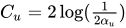 for the boundary values. If the maximum information and alternative reference are both specified, the BOUNDARYKEY=ALPHA option uses the specified value to compute the value and boundary values. The final-stage boundary value is modified to maintain the overall level if it exists. Similarly, the BOUNDARYKEY=BETA option uses the specified value to compute the value and boundary values. The final-stage boundary value is modified to maintain the overall level if it exists.
If the maximum information and alternative reference are not both specified, the specified and values are used to derive boundary values. The BOUNDARYKEY=NONE option uses these boundary values without adjustment. The BOUNDARYKEY=ALPHA option modifies the final-stage boundary value to maintain the overall level if it exists. Similarly, the BOUNDARYKEY=BETA option modifies the final-stage boundary value to maintain the overall level if it exists.